Wednesday, December 29, 2010

Spiritual Calendar January, 2011

All the dates given below are as per the Banke Bihari Panchang of Vrindavan

1
st January: A Very Happy New Year to you and your family members.


Lord Ganesha

It's customary to bow at the holy feet of Lord Ganesha on the new year. The foremost god of the Hindu pantheon, Ganesha is beheld as the most auspicious God of new beginnings and widely worshipped as the supreme god of wisdom, prosperity and good fortune.


Lord Shiva & Goddess Parvati

Soon after, we must propitiate Ganesha's parents, Lord Shiva and Goddess Parvati.


Lord Shiva or 'The Auspicious One', works for our well being, is the refuge of loving tenderness, is splendidly generous, bestows religious devotion to Krishna and is maha yogeshwar. Shiva, the supreme Vaishnava, is often venerated as the adi guru who resides in spiritual mentors of this mundane world. Easily pleased, Lord Shankar manifested for our Bobo in Vrindavan and made this spectral revelation that he was her spiritual preceptor for Krishna's madhurya or sweet love.


1st January, 2011: Lord Shiva Pradosha


Lord Shiva

Pradosh means dusk and this fast is kept for propitiating Lord Shiva. With his blessings all desires are fulfilled and one attains spiritual enlightenment. Generally people observe the Pradosha Vrata on every trayodashi tithi (13th lunar day falling in Krishna and Shukla Pakshas) in the evening. Thus please offer plain water and bel patra to Lord Shiva to herald the New Year of 2011 with an auspicious note. The bel patra or leaf of the wood-apple tree represents the three eyes of lord Shiva and the three gunas, as mentioned in the Puranas and scriptures at various instances.


Lord Vishnu

Thereafter invoke the grace of Lord Vishnu, the maintainer of the Universe. So that he may bless us with a peaceful and prosperous new year, chant the Vishnu Sahasranaama or 1000 names of Vishnu.


The Hindu Nav Varsh Begins on Chaitra Pratipada

Though the Hindu Nav Varsh starts on Chaitra Pratipada (the first month, of the Hindu lunar year,March to April)as per the Shri Banke Bihari Panchang of Vrindavan.The Hindu New Year is observed on Chaitra Shukla Pratipada (4th April 2011), the day after Amavasya. Chaitra Navratri or Basant Navratri begins on Nav Varsh or the day of Chaitra Pratipada and ends on Sri Ram Navami.


Heartiest congratulations to respected uncle Laxmi and Vrinda on birthday of 1st January,2011.


4th January, 2011: Poush Amavasya (tenth month of the Hindu lunar calendar,22nd dec 2010 to 19th January 2011) the first new moon day of the New Year attracts a large number of devotees from all over the world.


Devotees Take a Dip on Poush Amavasya

Considered auspicious for Hindus, many devotees visit sacred rivers and take a dip early in the morning and offer oblations (tarpan) to their departed ancestors. Hindus offer Pinda and Shraddh karma to dead ancestors.


Shri Banke Bihari ji in Vrindavan

One can hear the Shri Banke Bihari Aarti and the Shri Banke Bihari Ashtak at the www.bihariji.org. The Ashtak is a compilation of eight verses in Sanskrit dedicated to the praise of Shri Banke Bihari Maharaj and composed by Shri Jagdish Goswami when the present temple was being constructed in the 1860’s. Recitation of the ashtak or octet relieves the devotee of worldly worries and above all ensures sharanagati which means he finds lasting peace in the lotus feet of Shri Bankey Bihari.


Swami Shri Haridas

The devotional compositions of Swami Haridas compiled under the heading of Kelimal can be chanted. The word Kelimal means garland (Mal or Mala) of plays (Keli). This volume consists of 110 compositions in Indian classical music and is dedicated to the romantic dalliance of Shyama-Shyam in the nikunja or Nikunj Keli.


Siddhant Ke Ashtadash Pad (eighteen poems of principles): Swami Haridas came to Vrindavan in the sixteenth century AD. when the country had already seen foreign aggressions. The knowledge of Sanskrit and ancient philosophy had become extinct but these times were relatively peaceful as Akbar pursued a path of reconciliation.


During that period Swami Haridas composed these eighteen quadruplets containing the extract of philosophy in Braj bhasha, the language of common man. The complex relationship between the world, soul, creator and maya who runs the world has been explained in simple words. The true nature of the soul and salvation by total surrender to His desire (as expounded in Shrimad Bhagvat Gita and other epics) is also dwelt upon.


12th January, 2011: The Birthday of Swami Vivekananda


Swami Vivekananda

Swami Vivekananda (January 12, 1863–July 4, 1902),was the chief disciple of the 19th century Sri Ramakrishna Paramahamsa and founded the Ramakrishna Mission. He introduced the Hindu philosophies of Vedanta and Yoga in Europe and America and brought Hinduism to the status of a world religion by end of the 19th century. Swami Vivekananda was born in an aristocratic Bengali family of Calcutta in 1863. Swami's father by his rational mind and the mother by her religious temperament influenced his thinking. While searching for someone who could directly demonstrate the reality of God, he came to Ramakrishna and became his disciple. Ramakrishna taught him the philosophy of Advaita Vedanta or non-dualism and that service to man was the most effective worship of God.

14th January, 2011: Makar Sankranti or worship of the Sun God. Makar Sankranti is a major harvest festival celebrated in various parts of India. The movement of the earth from one zodiac sign into another is called Sankranti and as the Sun moves into the Capricorn zodiac it is known as Makar in Hindi.


The Sun God is Worshipped on Makar Sankranti

Makar Sankranti is also regarded as the beginning of an auspicious phase and ends the inauspicious phase which begins around mid-December. It is believed that any sacred ritual can be sanctified in a Hindu family from this day onwards.Sankranti marks the termination of the winter season and the onset of spring.


Devotees Bathe on Makar Sankranti

At Vrindavan, Rishikesh and Allahabad millions of devotees will take a dip in the holy River Yamuna or the Ganges on this pious day. Invariably they will give charity to the needy .


Bhagwan Surya-Narayan is considered the ancestor of Lord Ram ji and the very first disciple of Lord Sri Krishna in the Bhagavat Gita and will be worshipped with joyous abandon.


Shri Radha Vallabha Thakurs in Vrindavan

Today a bhoga of khichdi will be offered to Sri Yugal Sarkar or Thakurji particularly at the Radha Vallabh ji Temple at the holy dham of Vrindavan. We must also offer khichdi bhoga to our ishtdev or family deity and liberally donate it to brahmins and the needy.


Let us humbly bow at the holy feet of Mahaprabhu Hit Harivanshji and sing:

Govind Gopinath Gopijan Vallabh

dehi pad pallav, hey Radhavallabh

which means Thakurji or Lord of Mahaprabhu Hit Harivanshji kindly bless us with thy grace, divine love & holy feet.


16th Jan, 2011: Putrada Ekadashi.The ekadashi is celebrated on the eleventh day of Shukla Paksha in the Poush Month.


Lord Vishnu is Worshipped on Putrada Ekadashi

Rituals: On this day Lord Vishnu is worshipped and one keeps a fast for children. The devotees keeping a fast, wake up early in the morning and bathing soon after, worship Lord with due respect. Their children have long lives and couples who are childless are blessed with a child.


The Legend of Putrada Ekadashi

A man named Suketu and his wife Shaiya were very sad since they did not have any child. Suketu decided to commit suicide and went into the jungle, leaving his wife alone. And after many days, when he sat famished under a tree, a sage came to Suketu and asked his problem. Suketu told him the reason for his sorrow and thereafter the sage advised him to observe the Putrada Ekadashi Vrat. Suketu was very happy and immediately went back home. He kept the Putrda Ekadashi fast with his wife and after sometime they got a healthy child and lived happily thereafter.


17th January 2011: Lord Shiva's Pradosha Fast


Lord Shiva

19th January, 2011: Paush Poornima.

Paush Purnima is the full moon day of the Poush Month. It is considered very auspicious as the Magh Mela and its Snan starts at the Allahabad Prayag Triveni Sangam.


Hindus Take a Dip in the Triveni Sangam on Paush Purnima

Hindus believe that taking a holy dip at the Triveni Sangam in Allahabad, or any other location of holy rivers like the Ganga, Yamuna, Godavari, Krishna, Cauvery and Brahmaputra is very auspicious and expiates the sins committed in their lives.


The festivals of Shakambari Jayanthi and Shakambari Purnima are celebrated on Paush Purnima and it is the last day of Poush Navratras.


Mount Goverdhan

Our friends in Dubai can mentally do the parikrama or circumambulate Mount Goverdhan. Shri Giriraj is blessed because it here that Lord Krishna spreads His joy and expresses His love. If one does parikrama of the mountain just once he is expiated from all sins. Finally attaining His favoured deity, goes to Vaikuntha because Shri Radha's Pranvallabha or Lord Krishna adorns the peak of Shri Govardhan.


23rd January, 2011: We have the monthly Sri Hari Kirtan from 5 to 7 pm at Mr.S.M.Bhatnagar's place.

Shri Hari Kirtan

30th January, 2011: Shat-Tila Ekadashi is observed on Krishna Paksha Ekadashi of the Magh Month (eleventh month of the Hindu lunar calendar, January to February).


Lord Vishnu on Shat-Tila Ekadashi

Til means sesame seeds and shat stands for six. The entire offering of six types of sesame seeds on Shat-tila Ekadasi is considered highly meritorious. Reciting the Vishnu Sahasra Nama stotram (thousand names of Vishnu) and worshipping Lord Vishnu is a must for devotees.


Please offer til-ladoos to Lord Vishnu, Ganesha, your ishtdev or family deity, the child form of Krishna or Lord Rama in your home. As til is considered beneficial for the cold winter months, kindly donate the sesame seeds to needy students and the poor, liberally this season .

Sunday, December 26, 2010

The Madhurashtakam by Shripad Vallabhacharya ji

adharam madhuram vadanam madhuram

nayanam madhuram hasitam madhuram |

hridayam madhuram gamanam madhuram

madhur-adhipater akhilam madhuram ||1||


Sri Krishna is Nothing But Madhurya

His lips are sweet, His face is sweet,

His eyes are sweet, His smile is sweet.

He has a lovingly tender heart and His gait is also very gentle.

Everything is absolutely sweet about the Madhuradhipati or the Lord of sweetness.1


vachanam madhuram charitam madhuram

vasanam madhuram valitam madhuram |

chalitam madhuram bhramitam madhuram

madhur-adhipater akhilam madhuram ||2||


Krishna Wanders Around Sweetly

His words are sweet, His temperament is sweet,

His clothes are evocative, His flirtatious gestures are sweet

His delicate movements are sweet and He wanders around sweetly,

Everything is absolutely sweet about the Madhuradhipati or the Lord of sweetness.2


venur madhuro renur madhurah

panir madhurah padau madhurao |

nrityam madhuram shakhyam madhuram

madhur-adhipater akhilam madhuram ||3||


The Mellifluous Flute-play of Krishna

The Sweet Dust of Sri Krishna's Feet

His flute-play is melodious, the dust of his feet is sweet,

His lotus-hands are sweet, His feet are sweet,

His dance is ecstatic and His friendship is also very sweet.

Everything is absolutely sweet about the Madhuradhipati or the Lord of sweetness.3


gitam madhuram pitam madhuram

bhuktam madhuram suptam madhuram |

rupam madhuram tilakam madhuram

madhur-adhipater akhilam madhuram ||4||


Sri Krishna is Ineffably Beautiful & His Tilaka is Attractive

His singing exudes sweetness, His drinking is sweet,

His eating is sweet, His sleeping is sweet.

His beautiful form is attractive and His tilaka (sectarian mark on the forehead) is sweet,

Everything is absolutely sweet about the Madhuradhipati or the Lord of sweetness.4


karanam madhuram taranam madhuram

haranam madhuram ramanam madhuram |

vamitam madhuram shamitam madhuram

madhur-adhipater akhilam madhuram ||5||


Sri Krishna Captivates Us

His deeds are sweet and so is the path of His salvation,

The way he captivates our hearts is sweet and recollecting His playful dalliance is sweet,

His oblations (offerings) are sweet and His serenity is also very sweet.

Everything is absolutely sweet about the Madhuradhipati or the Lord of sweetness.5


gunja madhura mala madhura

yamuna madhura veechi madhura |

salilam madhuram kamalam madhuram

madhur-adhipater akhilam madhuram ||6||


Sri Krishna is Adorned with the Vanamala

His necklace made of gunja berries is sweet and so is His vanamala or flower garland,

His Yamuna is sweet and its rippling waves are sweet.

Its waters are sweet and so are lotuses blooming in the river.

Everything is absolutely sweet about the Madhuradhipati or the Lord of sweetness.6


gopi madhura lila madhura

yuktam madhuram muktam madhuram |

dhrishtam madhuram shishtam madhuram

madhur-adhipater akhilam madhuram ||7||


The Gopis Are Passionately Drawn by Sri Krishna

His gopis (enraptured cowherdesses with whom he sported in his youth) are sweet, His divine play is sweet,

The joy of belonging to Him is sweet and so is the pathos of longing for Him.

His sidelong glances are sweet and His graceful manners are also sweet.

Everything is absolutely sweet about the Madhuradhipati or the Lord of sweetness.7


gopa madhura gavo madhura

yastir madhura shristhir madhura |

dalitam madhuram phalitam madhuram

madhur-adhipater akhilam madhuram ||8||


The Gopas & Cows are Sri Krishna's Wealth

His gopas (cowherd friends) are sweet, His cows are sweet

His lakuti (a small club especially held by Krishna) is sweet, His creation is sweet,

His triumph (trampling) is sweet and its fruition is also very sweet.

Everything is absolutely sweet about the Madhuradhipati or the Lord of sweetness.8


Iti srimad vallabhacharya critam madhurashtakam sampoornam ||


Sripad Vallabacharya & Shri Nath ji Thakur
Thus ends the madhurashtakam, an octet of eight stanzas, composed by Sripad Vallabhacharya.

Sri Madhurashtakam: Introduction

Mahaprabhu Vallabhacharya ji
The Madhurasthakam, composed by Sri Vallabhacharya is a unique stotra, describing the sweetness of Lord Krishna. Originally written in Sanskrit, the ashtakam or octet is easily understood. The world is seen through the eyes of a spiritually evolved person in this composition of Mahaprabhu Vallabhacharya ji.


Sri Krishna, the Paragon of Sweetness

Shri Vallabhacharya posits Krishna as the paragon of sweetness and hence gives him epithets such as madhupati. Krishna exudes madhurya through his acts and his gestures, his words and his flute, his clothes and his sports. His madhurya or sweet love is richly shared with the gopis of Vrindavan. With tenderness and teasing, and the beauty of his dark body, Krishna enflames the desire of the individuated soul for union with the Divine.


Vallabhacharya (1479-1531) was a famous 16th century sage-philosopher of India and an ardent devotee of Lord Krishna. He was born in Champaran near Raipur in Chhattisgarh, a state of India. Shripad Vallabhacharya is particularly known as the founder of the Pushti Marg, a sect of the Hindu Religion, and is one of the five main acharyas who made a significant contribution to the bhakti movement.


Vallabhacharya ji's Philosophy of Shudh Advaita

On his first all India pilgrimage at the age of eleven, Vallabhacharya's brahmavad philosophy of shudha advaita or pure non-dualism proved that the material world is a manifestation of brahman and as such is true and not illusory or maya. Ordinary life here is conceived of as parallel with the other cosmic life of Krishna.


Shri Nathji

During the second pilgrimage, Lord Krishna appeared in the form of Shrinathji, ordering Vallabhacharya to re-establish the Pushti Marg (the path of tending the soul) and bring back the chosen ones to Vaikunth or Golok, where Krishna forever dwells.However Shri Vallabha felt that the priests were laying great stress on rites and rituals whereas individuals were influenced by the mundane world, and had lost the purity needed for becoming one with the Divine.


Thakur Shrinath ji Giving the Brahmasambandha Mantra to Vallabhacharya ji

Thereafter Thakur Shrinathji taught him the Brahamasambandha Mantra on the night of Pavitra Ekadashi of the Shravan Month. With this mantra all worldly impurities of the person initiated into the Pushti Marg would be abandoned and it would help him to surrender completely to Krishna. Personal seva remains the primary form and expression of devotion in the Pushti Marg. In seva or service to the Lord's svarupa, the devotee attends selflessly to the needs of the Lord and glorifies Him by assuming a particular relationship with the Lord.


Child Krishna Lifts Mount Goverdhan

Shri Nathji is the deity form of child Krishna who lifted Mount Govardhana at the age of seven to protect the inhabitants of Vrindavan from torrential rain sent by Indra.The svarupa of Shri Nath ji is shown with his left hand raised and the right hand closed in a fist and resting on his hip. His followers worship him both as Shri Radhanath or the Lord of Radha and as Bala Krishna, the mischievous, naughty child.


The Nathdwara Temple

Shrinathji is enshrined in Nathdwara near Udaipur in Rajasthan, and is the presiding deity of the Pushti Margis. Krishna in his form of Sri Nathji is also worshipped throughout India by followers of Bhakti Yoga and the Vaishnava traditions, especially within Gujarat.


Sant Surdas

The chance meeting of Sant Surdas' with Shrimad Vallabhacharya at Gau Ghat by the Yamuna in his teens, transformed his life. Shri Vallabhacharya gave him lessons in Hindu philosophy and put him on the path of spirituality. Since Surdas could recite the entire Srimad Bhagavatam and was inclined to music, his guru advised him to sing devotional ballads in praise of Lord Krishna and Radha. Surdas lived in Vrindavan with his spiritual preceptor who initiated him to his own religious order. Later on he was appointed as the resident singer of Srinath Temple in Govardhan.

Friday, December 24, 2010

Baba Shri Manohar Das ji, the Pride of the Spiritual World-XX

Rishikesh


Satsang was going on at the Geeta Bhavan located in Rishikesh. When Baba stepped out after listening to the devotional hymns, he did not have the slightest inkling of where he had to go and stay as of now. He did not have any wealth with him. 

Precisely then a saint named Swami Shri Krishnanand Ramayani came and asked him, “ Where will you go?” 

 “I do not know,” Baba replied instinctively.

 “ Come along with me,” urged the Swami.


Manohar Baba


Baba thought why not, since he just had to pass his time. He accompanied him to Shahjahanpur. Baba began to live in the orchard of Shri Shiv Prasad ji, a rich businessman known to saint Krishanand Ramayani. An elderly saint by the name of Shri Ram Bhikshuk ji was already staying in the orchard before Babar arrived. He also developed great affection for Baba.

When Baba would go to the well to bathe he would wash his clothes and left them out to dry in the sun. Swami Krishanand Ramayani would invariably fold those clothes when they had dried and keep them at the head of Baba's bed. 

On Baba's asking as to why he took so much trouble, Swami ji would say, “Aren't you our child.”

While living here Baba had looseness of the bowels (diarrhoea). He took several medicines but they were of no use. Then on the suggestion of Swami Krishanand Ramayani he began to eat boiled vegetables and lived on this diet for a span of six months.


The Ramayana


Swami Shri Krishanand Ramayani used to give discourses on the Ramayana. Once it so happened that he zealously insisted that Baba also speak on the Ramayana at a place which was closeby. Baba had no practice of giving lectures therefore he could barely speak for fifteen minutes on the first day. He managed to speak for half an hour on the second day.

Then onwards Baba got into the habit of speaking in an unbroken stream but he soon got bored with this regimen  within a period of four-six days. He contemplated as to what he would ultimately achieve by this routine. So Baba considered to safeguard himself from this entanglement. And that is the reason why he vanished the very next day, during the time of discourse and returned in the evening. Swami Krishanand Ramayani could figure out the mindset of Baba. Ever since, he never persisted that Baba should give a discourse.

Manohar Baba stayed there very peacefully with Shri Krishanand ji. And he would only eat fruits which the seth who owned the orchard had arranged for. All of a sudden, Baba began to see very fearsome and bad dreams. 

When Baba asked Shri Ram Bhikshuk, the saint who stayed with him, the reason for this development, Bhikshuk ji foretold, “The ordeal of death is going to befall you. If you carry out the anushthan or religious observance according to my prescribed method then your ordained death can be averted.” 

 On this suggestion, Baba retorted, “ I will not be able to follow this observance since I am from Vrindavan," Baba replied to this suggestion of his.


The Gajendra Moksha


That is when Ram Bhikshuk coaxed him, “ The siddh stotra of Gajendra Moksha is given in the Shrimad Bhagavad. You must start its paath (recitation) as a daily regimen.” 

Baba instinctively accepted this solution and he experienced the miraculous impact of this sanctified devotional hymn, soon after. (As per mythology elephant Gajendra's leg was caught by a crocodile in the pond and the two struggled for a thousand years. Gajendra lost a lot of blood and called out to Lord Narayan to save him. Lord Vishnu appeared on Garuda, his vehicle and killed the crocodile with his discus. Shri Hari it sure to save whoever prays to him.)

Wednesday, December 22, 2010

Baba Shri Manohar Das ji, the Pride of the Spiritual World-XIX

The Swaminarayan Temple, Rajkot


Once when highly revered Shri Maharaj ji had gone to Rajkot, the condition of Manohar Baba deteriorated considerably on being separated from him. It seemed as if he would not live now. However he completely recovered, most unexpectedly.

Balkrishan Das ji Maharaj Blessing Manohar Baba


On coming back, revered Thakurj ji who had accompanied Shri Maharaj ji to Rajkot secretly revealed to Baba, “One fine night, Shri Maharaj ji woke up drowsily, all of a sudden and sat down in Rajkot. Tears were streaming down from his eyes, constantly. He explained that Manohar ji is very distressed and longing for him Therefore I hugged him to my heart and bathed him with my flowing tears. But you must certainly not tell him this matter.”

 Hearing this exposition Baba was speechless. And he just could not figure out whether he should call this incident an expression of Maharaj ji's blessing or curse.

Dark-hued Krishna Playfully Dallied with Shri Girija


During those days Bhaktimati Shri Girija, an accomplished saint of the royal family of Jamira, used to live in Vrindavan. She used to claim that she was a yagna patni of the dwapara era and Thakur ji used to playfully dally with her. She had immense respect for highly revered Shri Maharaj ji.Off and on, Manohar Baba would go to meet her.

 “This great man is playing a game to wash out the harsh deeds performed in your earlier birth and this birth. Otherwise, his heart is brimming with affection for you,” she replied when he asked her the specific reason for Maharaj ji's separation from him.

Shri Radha Baba, Gorakhpur


When Shri Thakur ji, a great well-wisher of Manohar Baba, revealed the plight of Manohar ji to Shri Radha Baba, the renowned divine saint of Gorakhpur, who was not evidently known to highly revered Shri Maharaj ji in any way whatsoever,

“Bhaiya! It is only a siddh saint who can play such a game with his own servitor," replied Shri.Radha Baba . 


The Anguish of Separation from Krishna

He wants to heat him in the furnace of separation and offer his own attendant in the form of pure gold to Krishna, the Supreme Lover,.”


Bhaktimati Usha Bahenji,Vrindavan


In the year 1959, Bhaktimati Usha Bahenji, a pious saint, had renounced everything and come to Vrindavan for the sake of long standing devotion to the Divine. She had immense regard for Manohar Baba in her heart. Holding him in high esteem, she would always pay her respects to him. She would address Baba as Bhaiya and that is the reason why her entire parikar  called him 'Bhaiya ji'. 

Pujya Baba with Bhaktimati Usha Bahenji


She too was extremely distressed to see Baba's miserable condition. 

In those days she had written to one of her very close friends, “I have been introduced to such a saintly and eminent person in whose laughter also weeping is apparent, every moment.”


Rishikesh

\
Revered Manohar Baba was very miserable for all these reasons and left for Rishikesh, soon after. But the shelter of Shri Maharaj ji's grace protected him even there.

Friday, December 17, 2010

Baba Shri Manohar Das ji, the Pride of the Spiritual World-XVIII

Shri Manohar Baba with Balkrishan Das ji Maharaj


Manohar Baba's anguish on being separated from Shri Maharaj ji escalated to such an extent as if someone was turning his heart on a hot griddle and roasting it.Therefore Baba thought it was better to give up his body by going on a hunger strike till he died, instead of living a life without Shri Maharaj ji. Consequently he kept returning the meals which came from Gopal Mandir to his hut for six days at a stretch.

Shri Radha Rani


On the seventh day a gentleman from Mansarovar came with food to his house and coaxed him, “ Shri Radha Rani has appeared in my dreams and asked me to feed you.”

 Amazingly Baba had the meal and broke his fast.


Shri Balkrishan Das ji Maharaj


Later on it was learnt that it was not Radha Rani who had sent the food for him but rather his very own Maharaj ji. He was the one who by making Baba, his extremely close adherent a pawn was playing a fearsome game for some important objective. In the absence of Shri Maharaj ji, the days and nights were passing like an ordeal for Manohar Baba and he felt very much like a fish out of water.


Shri Santosh Bahenji


Santosh Bahenji had extreme reverential affection and selfless love for Baba. Once Baba was suffering from the unbearable pain of shiatica. Bahenji used to live in Gopinath Bazar in those days. Even on staying so far she would set out in the blazing afternoon every day as a regimen to give medicine and attend to the needs of Baba. Later when Baba sprained his foot she would make poultice etc from her kutiya and get it for him.

Manohar Baba stayed in a hut made on the Suraj Ghat. Out of affection, Bahenji would make all arrangements of serving him and took care of his needs and comforts. Baba made full use of the quilt as well as the aasan (seat of cloth) made by Bahenji till the last days of his life. Manohar Baba always regarded her as his elder sister and would never hide any matter from her.


Shri Narad Muni


At times she would tease Baba and call him Narad Muni(one of the four sons of Brahma, who is a devotee of Krishna and a tale-bearer).

On Ekadashi, Baba would invariably get phalahar (a meal of fruit) at her residence. Once Santosh Bahenji went to Baba's kutiya in Suraj Ghat to have his darshan. 

“Bhaiya! Can I come up?”She called out from below.


Maa Sita in Ashok Vatika


Baba instinctively replied, “ What will you do by venturing upstairs? I am in Ashok Vatika.”(a garden in Lanka where Sita the wife of Rama was held captive by Ravana, the demon king, after her abduction).

 In this manner Baba was absorbed and suffering the anguish of separation from Shri Maharaj ji, his virtuous guru.


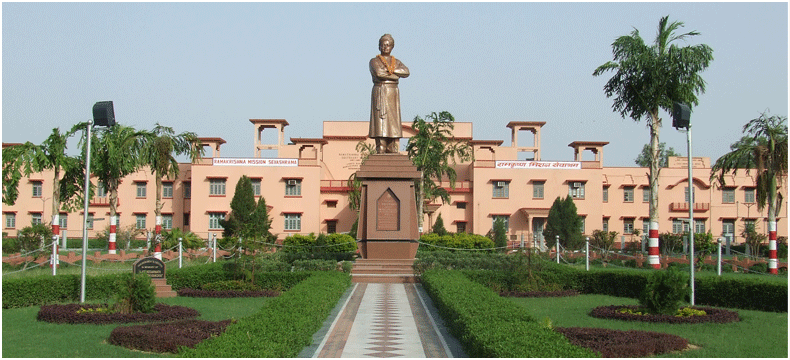
Ramakrishna Seva Ashram, Vrindavan


During the last stage of her life when Santosh Bahenji was admitted in the Ramakrishna Mission Seva Ashram of Vrindavan, Baba had gone to Barwani for sankirtan (a congregation chanting) of the 'mahamantra.' 

Only after Baba came back to Vrindavan and met her, did Bahen ji leave her body, the very next day. Actually speaking,by using his transcendental and supernatural power Baba had not let Bahenji depart from this mundane world in his absence.


Golok, the Eternal Nikuna


After Bahenji gained entry into the eternal nikunja (merged with Lord Krishna) Manohar Baba was the one who did her antyeshti (funeral rites), had paath of the Shrimad Bhagavat done, held a smriti sabha (gathering in her memory), gave meals to brahmans and sadhus, and got memoirs published in her auspicious memory. (Page 368 of 'Smriti Kaumudi, the memoirs of Shri Manohar Baba)